Choosing between SAP and Odoo comes down to your budget, your company size, and how much flexibility you need from your ERP system. SAP fits large enterprises with complex global operations and big IT budgets. Odoo fits small and mid-sized businesses that need fast deployment, lower cost, and room to grow without locking into rigid contracts.
Both platforms manage finance, inventory, sales, and operations from one system. The real difference shows up in cost, implementation time, and how much control you get over the software. This guide breaks down the advantages of Odoo, its disadvantages, how it stacks up against SAP, and who actually competes with SAP at the enterprise level.
SAP vs Odoo: Core Differences
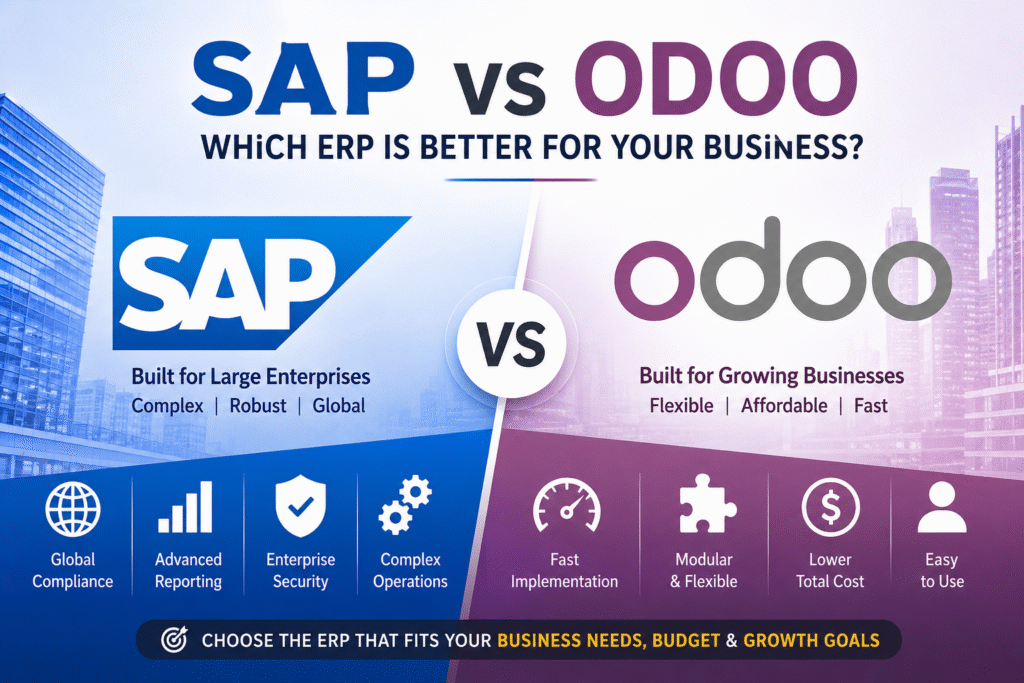
SAP is built for large enterprises with deep pockets and complex compliance needs. Odoo is built for businesses that want enterprise-level features without the enterprise-level price tag. Here is how the two compare on the factors that matter most.
| Factor | SAP | Odoo |
| Target business size | Large enterprises, multinational corporations | Small to mid-sized businesses, growing companies |
| Implementation time | 12 to 24 months for full rollouts | 2 to 6 months for most deployments |
| Cost structure | High licensing fees plus consultant costs | Lower licensing cost, modular pricing by app |
| Customization | Requires specialized SAP developers | Open source code, easier to customize |
| Best fit | Companies with complex global compliance needs | Companies that want speed and lower total cost |
If you run a large multinational with thousands of employees and need deep compliance support across many countries, SAP gives you that depth. If you run a small or mid-sized business and want an ERP that goes live in months instead of years, Odoo gives you that speed.
Advantages of Odoo
Odoo has grown into one of the most popular ERP platforms for small and mid-sized businesses. Here is why companies choose it over heavier systems like SAP.
Lower total cost
Odoo charges per app and per user. You pay for the modules you need, not a full enterprise suite. This keeps costs predictable and lets you scale spending as your business grows.
Faster implementation
Most Odoo deployments go live in a few months. SAP rollouts often take a year or longer because of the complexity involved in configuring large enterprise environments. Speed matters when you need your ERP running now, not next year.
Open source flexibility
Odoo runs on open source code. Developers can customize modules directly without waiting on vendor approval. This gives businesses more control over how the system fits their workflow.
All in one modules
Odoo covers accounting, inventory, manufacturing, CRM, HR, and ecommerce in one connected system. You avoid the cost and hassle of stitching together separate software for each department.
Easier to learn
Odoo uses a clean, modern interface. Teams need less training time compared to SAP, which has a steeper learning curve and often requires dedicated specialists to operate.
Disadvantages of Odoo
Odoo is not the right fit for every business. Before you commit, weigh these limitations against your operational needs.
Limited for very large enterprises
Odoo can struggle with the scale and complexity that massive global enterprises need. Companies running operations across dozens of countries with heavy regulatory demands often outgrow what Odoo offers natively.
Customization needs developer support
Basic setup is simple, but deeper customization requires a developer who understands Odoo’s framework. Without the right technical partner, you risk a system that does not match your actual workflow.
Support quality varies by partner
Odoo relies on a network of implementation partners. Support quality depends heavily on which partner you choose. A weak partner means slower fixes and a rougher rollout.
Reporting tools are basic out of the box
Native reporting in Odoo covers the basics well, but advanced analytics often need third party tools or custom development. SAP offers deeper built-in reporting for complex enterprise analysis.
Module quality is inconsistent
Odoo has a large marketplace of third party apps. Quality varies widely between modules, so you need to vet apps carefully before adding them to a production system.
Who Is the Biggest Competitor of SAP
Microsoft Dynamics 365 holds the largest share of the ERP market among SAP’s direct competitors, ahead of Workday and SAP’s own S/4HANA platform. Microsoft’s advantage comes from its existing footprint inside companies that already run Office 365, Azure, and Power BI, which makes Dynamics an easy add-on rather than a separate system to learn.
Oracle NetSuite is the other major name in this space. NetSuite focuses on companies managing multiple subsidiaries and currencies, and it competes directly with SAP for mid-market and enterprise clients that want a cloud-native platform instead of a legacy on-premise system.
Odoo competes with SAP in a different segment. Instead of going after large enterprise accounts, Odoo wins business from companies that find SAP too expensive or too slow to implement. This is the segment where most small and mid-sized businesses, including many in Hong Kong and across the Greater Bay Area, end up comparing the two platforms directly.
Which Should You Choose
Choose SAP if you run a large enterprise with complex compliance needs across multiple countries and you have the budget for a long implementation timeline. SAP gives you depth in reporting, global tax handling, and industry specific modules that large organizations rely on.
Choose Odoo if you run a small or mid-sized business and want to go live fast without paying enterprise level fees. Odoo gives you the core ERP functions you need, with the flexibility to add modules as your business grows.
Your decision should match your company size, your budget, and how much customization your operations actually require. Test both platforms against your specific workflow before committing, since the right ERP is the one that fits how your business actually runs, not the one with the biggest name.