Choosing the right ERP is one of the most important decisions a growing business will make. The wrong system costs you time, money, and momentum. Two platforms dominate the conversation in 2026: Odoo and Microsoft Dynamics 365. Both are capable. But they serve very different business profiles, and understanding that difference matters before you commit.
This post breaks down both platforms across cost, flexibility, scalability, and support so you get a clear picture of which fits your business.
What Is Odoo?
Odoo is an open-source ERP platform built on modular architecture. You start with the modules you need, such as accounting, inventory, CRM, or HR, and add more as your business grows. The community edition is free. The enterprise edition comes with a per-user monthly fee that stays competitive even at scale.
Odoo works well for small to mid-sized businesses that want full control over their setup without paying enterprise-level licensing fees from day one.
What Is Microsoft Dynamics 365?
Microsoft Dynamics 365 is a cloud-based suite of business applications from Microsoft. It covers ERP and CRM functions across separate modules: Finance, Supply Chain, Sales, Field Service, and more. Each module carries its own licensing cost, which adds up fast.
Dynamics 365 fits larger enterprises or businesses already deep in the Microsoft ecosystem, using Azure, Teams, or Power BI regularly.
Pricing: A Clear Gap
Odoo Enterprise starts around $24.90 per user per month for the standard plan. The community edition costs nothing for the software itself, though you will need developer resources to configure it.
Dynamics 365 pricing is harder to pin down because it depends on which modules you license. Business Central, the SMB-focused product, starts around $70 per user per month. The full Finance module runs over $180 per user per month. When you stack multiple modules, costs compound quickly.
For a 20-person team, Odoo could run under $500 per month. Dynamics 365 Business Central would likely cost $1,400 or more for the same headcount, without add-ons.
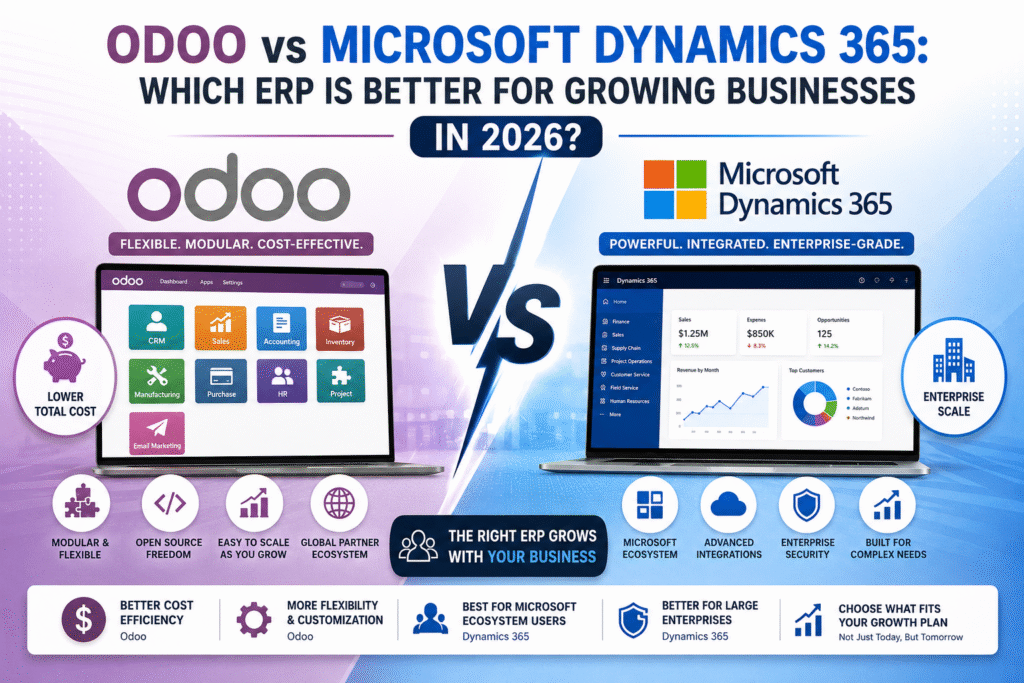
If budget efficiency is a priority, Odoo wins this round.
Flexibility and Customization
Odoo’s open-source foundation gives developers direct access to the codebase. You can build custom modules, modify existing ones, and tailor workflows to match how your team actually operates. Thousands of third-party apps exist in the Odoo marketplace.
Dynamics 365 offers customization through Power Platform, specifically Power Apps and Power Automate. This is powerful but works best when your team is already using Microsoft tools. Deep customizations often require certified Microsoft partners and can become expensive.
Odoo gives more flexibility to businesses that need bespoke processes. Dynamics 365 is better if your workflows map closely to Microsoft’s out-of-the-box functionality.
Ease of Use
Odoo has improved its interface significantly over recent versions. The UI is clean, and most modules are intuitive enough for non-technical staff to pick up quickly. The learning curve exists but is not steep for standard use cases.
Dynamics 365 has a steeper learning curve, especially for users new to Microsoft’s business application ecosystem. The interface is more complex, and navigation between modules requires adjustment time. Onboarding costs and training time are typically higher.
Integration Capabilities
Odoo integrates natively across its own modules. Accounting connects to inventory, which connects to sales, which connects to CRM. Everything shares a single database, so data flows without manual syncing.
Dynamics 365 integrates tightly with other Microsoft products: Outlook, Teams, Excel, Azure, and Power BI. If your team runs on Microsoft tools, those integrations feel seamless. Outside the Microsoft stack, integrations require more setup.
Odoo supports REST APIs and has connectors for common third-party tools. Dynamics 365 has a broader enterprise integration library but assumes more technical infrastructure.
Scalability
Both platforms scale. The question is how the cost curve looks as you grow.
Odoo scales without a dramatic jump in licensing fees. You add users and modules as needed. Moving from 20 to 200 employees is straightforward on the platform side.
Dynamics 365 scales well too, but costs grow significantly with headcount and module additions. Large enterprises with complex multi-entity structures or global operations may find the depth of Dynamics 365 more appropriate despite the cost.
For businesses in the growth phase, Odoo offers better cost-to-scale ratios.
Implementation and Support
Odoo has a global network of certified partners who handle implementation, customization, and ongoing support. If you are in Southeast Asia, working with an Odoo partner Malaysia can significantly reduce implementation time and localization effort, since regional partners understand local tax structures, compliance requirements, and business workflows.
Dynamics 365 implementations are larger projects by default. A mid-market deployment routinely runs six to twelve months and requires certified Microsoft partners. Implementation costs often exceed the first year of licensing.
Odoo implementations are faster for standard setups and more manageable in cost for growing businesses without dedicated IT departments.
Which Industries Prefer Which Platform?
Odoo tends to perform well in manufacturing, wholesale distribution, retail, professional services, and e-commerce. Its flexibility makes it popular with businesses that have non-standard processes.
Dynamics 365 performs well in financial services, large-scale supply chain operations, and enterprises with existing Microsoft infrastructure. It is the default choice for many Fortune 500 companies.
If your business is not yet at enterprise scale, Dynamics 365 brings features and complexity you will not use while charging you for them.
The Honest Comparison
Odoo is not the right choice for every business. If you run a 2,000-person company with complex global financials and a full Microsoft stack, Dynamics 365 probably fits better. Microsoft’s compliance tooling, audit trails, and integration with Azure services are harder to match.
But for businesses between 10 and 500 employees that want a full-featured ERP without the overhead of enterprise licensing, Odoo is harder to argue against in 2026. The platform has matured considerably, the support ecosystem is strong, and the cost advantage is real.
The decision comes down to where your business is now and where it needs to go in the next three years. If you are scaling fast and need control over your costs, Odoo gives you more room to grow without the financial ceiling that Dynamics 365 imposes early on.