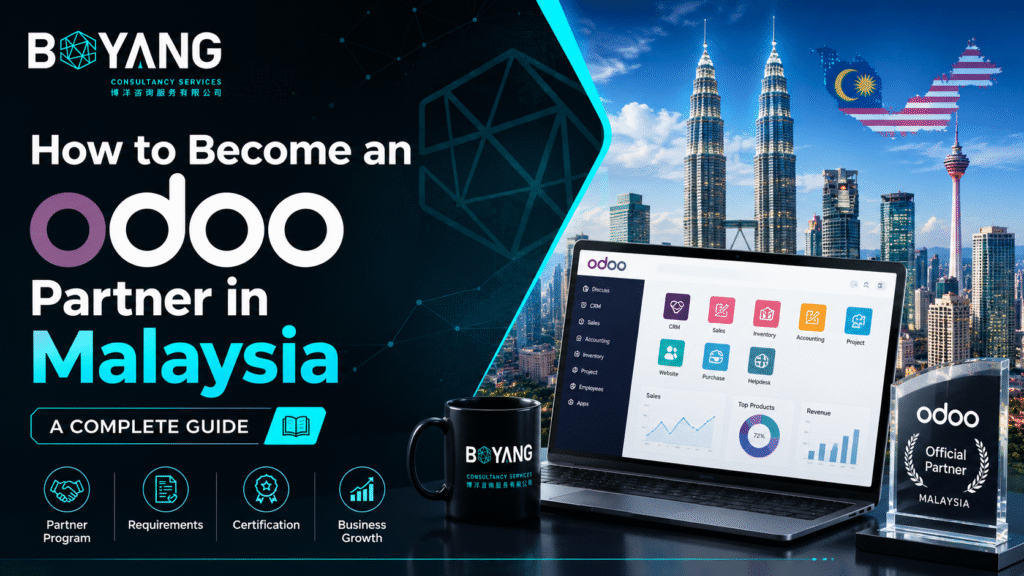
Malaysia’s ERP market is growing fast, and Odoo sits at the center of that growth. Businesses across Kuala Lumpur, Penang, and Johor are moving away from spreadsheets and disconnected tools toward one unified system that handles accounting, inventory, HR, and sales together. If you run an IT consultancy, a software house, or a freelance implementation team, becoming an Odoo partner opens a direct path into this demand.
This guide walks you through what an Odoo partner actually does, the different partnership levels, the requirements for each, and the steps you need to take to apply. If you are based in Malaysia and considering this move, you will also find notes on why the local market, including LHDN e-invoicing compliance, makes this an especially good time to get certified.
What Does It Mean to Be an Odoo Partner?
An Odoo partner is a company officially recognized by Odoo to sell, implement, customize, and support Odoo software for clients. Partners are not resellers in the traditional sense. They act as the main point of contact for a business throughout its ERP journey, from the first consultation to configuration, staff training, and ongoing support.
Odoo relies on its partner network to deliver most of its client implementations. The software itself is open and modular, but making it work for a specific business, whether that is a manufacturing plant in Shah Alam or a retail chain in Kuala Lumpur, takes local expertise. That is the gap partners fill.
Once certified, your company gets listed on Odoo’s official partner directory, gains access to enterprise resources, and earns commission on software sales. For a Malaysian business, this also means positioning yourself as the go-to name for Odoo projects in your region.
The Odoo Partner Levels Explained
Odoo structures its partner program into four levels. Each level has its own requirements and its own set of benefits. Understanding where you fit helps you plan a realistic path forward instead of aiming for a tier your team is not ready for yet.
Learning Partner
This is the starting point. Learning Partners are new to the Odoo ecosystem and are building up their internal knowledge before taking on client projects at scale. There is no minimum number of Enterprise licenses sold and no certification requirement yet, but the company must show genuine intent to grow with Odoo.
Ready Partner
Ready Partners have completed their first projects and are ready to formalize their status. To reach this level, your company generally needs to sell at least 10 new Odoo Enterprise users per year and have at least one certified employee on staff. Ready Partners appear on the official partner page and start receiving leads directly from Odoo.
Silver Partner
Silver status signals real experience. It usually requires around 50 new Enterprise users sold annually, at least two certified employees, and a client retention rate of about 70 percent. Retention rate measures how many of your active Odoo contracts stay active over a 12 month period, which tells Odoo whether your implementations actually stick.
Gold Partner
Gold is the highest tier and reflects a company with Odoo at the core of its business strategy. Requirements typically include around 150 new Enterprise users sold per year, at least three certified employees, and a retention rate of 80 percent or higher. Gold Partners get the highest visibility on Odoo’s directory and the strongest commission rates.
Your level is reviewed quarterly, and Odoo automatically upgrades you once you meet the requirements for the next tier. There is no need to reapply from scratch each time.
Requirements to Become an Odoo Partner
Before you apply, make sure your company can meet these core requirements.
Certified staff
You need team members who hold official Odoo certifications. These certifications prove your consultants understand the platform’s functional and technical sides well enough to configure it correctly for a client. Odoo runs certification exams for each major version, and your certified staff need to stay current as new versions release.
Proven implementation experience
Odoo wants to see that your team can actually deliver. This does not mean you need dozens of finished projects before you apply, but you do need evidence of successful deployments, whether for paying clients or well-documented internal projects.
Training commitment
Partners are expected to attend official Odoo training sessions. The number required increases as you move up the tiers: Ready Partners need at least one session, Silver Partners need two, and Gold Partners need more.
Dedicated resources
Odoo expects partners to assign specific staff to Odoo projects rather than treating it as one product among many with no clear ownership. This shows Odoo, and your future clients, that you take the platform seriously.
Support capability
You need to act as the first line of support for your clients, with Odoo serving as backup for harder technical issues. This means having a support process in place, not just a sales team.
Annual fee
Becoming a Ready Partner and above involves an annual partnership fee. Odoo does not publish this figure openly, so you will need to confirm current pricing directly with your regional Odoo account manager during the application process.
Step by Step: How to Apply
Step 1: Research the program thoroughly
Before applying, get familiar with Odoo’s core modules, its target markets, and where your company’s strengths fit. Look at Odoo’s documentation and study which industries in Malaysia have the strongest demand for ERP, such as manufacturing, retail, and professional services.
Step 2: Build initial project experience
If your team has not implemented Odoo before, start with a smaller internal project or take on a first client at a reduced rate to build a track record. This experience becomes your proof point during the application.
Step 3: Get your team certified
Enroll your consultants in Odoo’s certification programs. These cover functional consulting, technical development, and specific modules like accounting or inventory. Certification is personal to each employee, so plan for staff turnover and keep your certified headcount stable.
Step 4: Submit your partner application
Visit Odoo’s official “Become a Partner” page and submit your application with details about your company, your team’s experience, and your business plan for Odoo. Odoo’s regional team, which covers Southeast Asia including Malaysia, will review your submission.
Step 5: Attend onboarding and training
Once accepted, you will get access to the partner portal, along with training resources and sales enablement materials. Complete the required training sessions for your target level.
Step 6: Deliver projects and track your metrics
Focus on closing your first Odoo Enterprise sales and keeping clients active long term. Your license sales, certified staff count, and retention rate all feed into your quarterly tier review.
Step 7: Maintain and grow your status
Keep training your team on new Odoo releases, stay responsive on client support, and keep selling. As your numbers grow, Odoo upgrades your partnership level automatically.
Why This Is a Good Time for Malaysian Companies
Malaysia’s push toward mandatory e-invoicing through LHDN has created a wave of demand for ERP systems that can handle compliance automatically. Odoo’s local partners are already building e-invoicing integrations tied directly to LHDN’s MyInvois portal, along with SST reporting and multi-currency support for businesses trading across the region.
This compliance requirement means Malaysian businesses are not just shopping for ERP software out of general interest. Many need a working, compliant system on a deadline. That urgency creates steady project demand for partners who understand both Odoo and Malaysian regulatory requirements.
Beyond compliance, Malaysia’s SME sector is large and still under-digitized compared to bigger markets. Odoo’s modular pricing means SMEs can start with one app, such as accounting, and expand later. This makes it an easier sell for smaller businesses that are not ready for a full ERP rollout on day one, and it gives partners a natural path to grow each account over time.
Benefits of Becoming an Odoo Partner
Direct commission on sales. Partners earn commission on Odoo Enterprise licenses, with rates increasing at higher tiers, plus a separate commission structure on Odoo.sh hosting.
Lead generation. Odoo sends leads to partners based on their region and industry focus, which reduces how much you need to spend on outbound sales.
Official visibility. Your company gets listed on Odoo’s partner directory, which is often the first place a business looks when searching for implementation help.
Access to enterprise resources. Partners get access to Odoo Enterprise source code repositories, priority bug reporting, and a dedicated account manager for strategic questions.
Recurring revenue. ERP clients need ongoing support, upgrades, and new module rollouts. Once you land a client, the relationship tends to continue for years.
What to Expect After You Apply
In the first few weeks, you will hear back on your application status and, if accepted, get access to the partner portal and initial onboarding material.
Over the first couple of months, your team should focus on completing required certifications and closing your first tracked license sales as a partner.
Within four to six months, your retention rate and sales numbers start to shape which tier you qualify for at your first quarterly review.
On an ongoing basis, your focus shifts to keeping certifications current with new Odoo versions, maintaining strong client retention, and steadily growing your Enterprise license count to move up the partner ladder.
Final Thoughts
Becoming an Odoo partner in Malaysia takes real commitment: certified staff, proven delivery, and a genuine investment in client support. It is not a status you get overnight. But for companies willing to put in the work, it opens a direct channel to one of the fastest growing ERP markets in Southeast Asia, backed by official recognition, lead generation, and commission on every sale.
If your team already has ERP or software implementation experience, the path to Ready Partner status is closer than it might seem. Start with certification, take on your first Odoo project with full commitment, and build from there.