SOC as a Service in Malaysia: What SMEs Need to Know
Most Malaysian SMEs discover they have a cybersecurity problem the worst possible way: after something has already gone wrong. A ransomware note on the office server on a Monday morning. A customer calling to ask why their invoice email looks suspicious. A supplier whose finance team wired payment to a scammer impersonating your accounts department. By then, the damage is measured in six figures, lost contracts, and a reputation that took years to build.
The traditional answer — building your own Security Operations Centre — is financial fantasy for most SMEs: a single experienced security analyst in Malaysia commands RM8,000 to RM15,000 a month, and one person cannot cover 24 hours a day anyway.
SOC as a service Malaysia providers solve exactly this mismatch. Instead of building your own security team, you rent one: a fully staffed operations centre that monitors your network, detects threats, and responds to incidents on your behalf, usually for a predictable monthly fee. This guide explains what you actually get, what it costs in Malaysia, and how to choose a provider without getting burned.
What Is SOC as a Service?
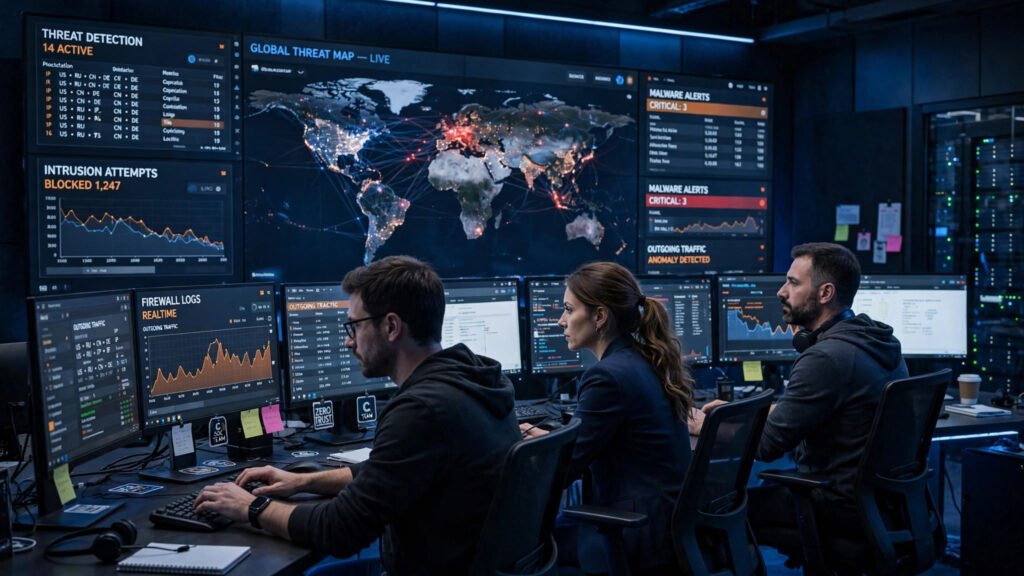
A Security Operations Centre is the nerve centre of an organisation’s cyber defence. Analysts sit in front of dashboards fed by sensors across the network — firewalls, servers, laptops, cloud applications — watching for signs of attack: unusual login times, malware signatures, data being exfiltrated to unknown servers, an employee clicking a phishing link at 2am. When something looks wrong, they investigate, contain it, and escalate.
SOC as a Service (SOCaaS) delivers that entire function as a subscription. The provider owns the platform, staffs analysts across shifts, and maintains threat intelligence feeds; you install lightweight agents and connect your logs. You get continuous protection and incident response without recruiting scarce security talent.
Why Malaysian SMEs Can’t Ignore This Anymore
Two forces have pushed SOC services from “nice to have” to “urgent” for smaller Malaysian businesses: attackers have moved downmarket, and regulators have raised the stakes.
Cyberattacks Are Hitting Smaller Companies First
Large enterprises — banks, GLCs, telcos — have spent a decade hardening defences, so attackers moved downmarket to SMEs with valuable data but thin protection. Business email compromise remains the country’s most expensive scam, with fraudsters intercepting real invoice threads to redirect payments. Ransomware affiliates now target even small distributors, and SMEs are attacked as stepping stones into bigger clients. A SOC catches the early signals — the odd login, the lateral movement — that a firewall alone never will.
PDPA Fines Make “We Didn’t Know” Expensive
Malaysia’s Personal Data Protection Act (PDPA) 2010 has teeth, and recent amendments raised penalties for breaches significantly. “We are only a small company” is not a defence the Commissioner accepts — you must demonstrate reasonable security measures and detect breaches fast enough to respond. Continuous monitoring is the practical way to meet that bar. Many SMEs first explore cybersecurity services in Malaysia because a client contract or PDPA audit forced the question.
What You Get: The Standard SOC as a Service Stack
Offerings vary, but a serious SOC as a service Malaysia package typically includes these components:
- 24/7 security monitoring: continuous watch over your network, endpoints, servers, and cloud services (Microsoft 365, Google Workspace) by analysts working in shifts.
- SIEM platform and log management: centralised collection and correlation of security logs, usually with at least 12 months of retention for investigation and compliance.
- Threat detection and triage: real-time analysis of alerts, with false positives filtered out so your team only hears about genuine issues.
- Incident response: a defined playbook — who does what, in what order — when a real attack is confirmed, including containment guidance and forensic support.
- Vulnerability management: regular scanning of your external and internal systems, with findings prioritised by actual exploitability rather than raw severity scores.
- Threat intelligence: feeds tuned to Southeast Asian campaigns actually targeting this region.
- Reporting: plain-language monthly summaries plus audit-ready evidence for PDPA or client security reviews.
Extras like penetration testing or phishing simulations are bonuses — the core is always detection speed and response quality. For how these pieces fit a complete programme, read our advanced cybersecurity guide.
SOC as a Service Pricing in Malaysia
Pricing scales with devices, users, and log sources monitored. Realistic Malaysian market bands:
- Basic monitoring (up to ~50 endpoints): RM4,000–RM8,000/month — business-hours-plus monitoring with on-call escalation, for small offices needing visibility and alerting.
- Full 24/7 SOCaaS (50–200 endpoints): RM10,000–RM25,000/month — genuine round-the-clock coverage with incident response and monthly reporting; the sweet spot for mid-sized companies.
- Enterprise-grade (200+ endpoints, multiple sites): RM30,000–RM80,000+/month — dedicated analysts, custom detection rules, threat hunting, SLA-backed response.
Building in-house — three analysts minimum for real 24/7, a SIEM licence, threat feeds, a manager — easily exceeds RM60,000/month before one alert is investigated, plus brutal staff turnover. SOC as a service Malaysia pricing is a fraction of that with coverage from day one. Watch for suspiciously low quotes (under RM3,000/month for real 24/7 coverage — the maths does not work) and contracts charging extra per incident-response hour.
In-House SOC vs SOC as a Service: An Honest Comparison
An in-house SOC gives you analysts who know your business intimately and full control over tools and data — but demands a security leader, a recruitment pipeline in Malaysia’s talent-starved market, and a budget most SMEs lack. Burnout is a real risk when a two-person team covers nights and weekends.
SOCaaS flips the trade-off: instant access to a mature team and analysts who have seen attacks across dozens of clients — so they recognise new threats faster than a team that has only defended one network. The downside: they will never know your business as deeply, and a third party holds your logs. A hybrid model works well: SOCaaS for 24/7 monitoring plus one internal coordinator owning policy and decisions. Either way, it should sit inside wider managed IT services, not as an isolated add-on.
Choosing a SOC Provider in Malaysia: 6 Checks
- Real 24/7 or “24/7”? Ask where analysts sit and how nights are staffed. Some resell overseas monitoring with a local account manager — fine if disclosed, not if sold as a Malaysian SOC.
- Response SLAs in writing: detection and response time commitments should be in the contract, not the brochure. Ask for the mean time to detect and respond from their last quarter.
- PDPA-aware processes: confirm the provider’s own PDPA compliance, log data residency, and retention policies.
- Tooling transparency: you should know which SIEM and endpoint agents will be deployed, and you should retain access to your own data and dashboards.
- Onboarding depth: proper onboarding includes asset discovery, alert tuning, and a tabletop incident exercise. “Install the agent and we’re live” is a walk-away signal.
- References in your industry: ask for two clients of similar size. A provider that only serves banks may not understand a manufacturer’s operational technology constraints.
Frequently Asked Questions
How is SOC as a Service different from antivirus or a firewall?
Antivirus and firewalls are tools; a SOC is people plus process plus tools. A firewall blocks known-bad traffic, but it cannot investigate whether your finance manager’s account is compromised or coordinate containment at 3am. SOCaaS provides the analysts who turn alerts into decisions and actions.
Does my SME really need 24/7 monitoring?
Malicious activity peaks outside business hours — attackers know your IT staff are asleep. If you hold customer data, process payments, or run systems that cannot go down, overnight coverage is where SOCaaS earns its fee.
Will a SOC provider have access to our sensitive data?
They will see security logs and metadata — usernames, IP addresses, file names. A reputable provider works under a strict NDA and data processing agreement, stores logs in defined jurisdictions, and shows you who accessed what. Raise this during evaluation, not after signing.
How long does it take to get a SOC service running?
Typically two to six weeks: agent deployment, log integration, alert tuning, and a vulnerability baseline. Anyone promising full protection on day one is skipping the tuning that prevents alert fatigue later.
The Bottom Line
For Malaysian SMEs, the question is no longer whether you can afford continuous monitoring — it is whether you can afford to operate without it. Between ransomware, PDPA enforcement, and supply-chain attacks treating small vendors as entry points, a 50-person company now carries a large company’s risk profile. SOC as a service Malaysia offerings close that gap at a budgetable price, without the hiring nightmare. Start with a conversation about your actual risk — not a product demo. Our team provides cybersecurity services in Malaysia including SOC advisory, and we will tell you honestly if you are not ready yet.