Odoo is one of the most flexible and scalable ERP platforms these days, and a major reason behind its success is its Model-View-Controller (MVC) architecture combined with a powerful three-tier backend structure.
Understanding the MVC architecture of Odoo is essential for developers, IT managers, and businesses planning an Odoo ERP implementation, even in Malaysia or globally. A clear architectural understanding helps organizations build scalable systems, maintain clean customizations, and ensure smooth upgrades in the future.
In this complete guide, we’ll cover:
- What MVC architecture means in Odoo
- How MVC works inside the Odoo framework
- Core backend and server architecture
- Role of Model, View, and Controller
- Odoo’s three-tier system design
- Practical development examples
- Why MVC makes Odoo highly scalable
What is MVC in Odoo?
MVC in Odoo refers to the Model-View-Controller design pattern, a structured software architecture that separates application responsibilities into independent layers.
The Odoo MVC architecture divides the system into:
- Model → Data structure & business logic
- View → User interface
- Controller → Request handling & workflow logic
This separation ensures better modularity, easier maintenance, and faster development cycles across the Odoo ecosystem.
Overview of Odoo Architecture
Beyond MVC, Odoo operates on a three-tier architecture, which make it superior in performance and scalability.
The overall Odoo architecture consists of:
- Odoo Server (Python-based backend)
- PostgreSQL Database
- Web Client (Frontend UI)
- ORM (Object-Relational Mapping) Layer
- XML View System
Controller Routing System
Odoo Three-Tier Architecture
1. Presentation Tier (Client Layer)
This is the user-facing interface.
- Web browser running the Odoo Web Client
- Single-page application experience
- Built using JavaScript framework components
- Handles user interaction and display rendering
Users interact with dashboards, forms, kanban views, and reports through this layer.
2. Application Tier (Business Logic Layer)
This is the core of the Odoo backend architecture.
Written primarily in Python, the Odoo server manages:
- Business workflows
- Module execution
- Reporting engines
- Authentication
- API communication
- Request processing
The application layer connects frontend requests with database operations through Odoo’s ORM system.
3. Data Tier (Database Layer)
Odoo exclusively uses PostgreSQL as its database engine.
Responsibilities include:
- Data persistence
- Transaction integrity
- Security enforcement
- Relationship management
- Performance optimization
Structured business data resides in PostgreSQL, while binary files such as images and attachments are stored in the Odoo Filestore, referenced from the database.
Core Components of Odoo Backend Architecture
Object-Relational Mapping (ORM)
The Odoo ORM allows developers to interact with database records using Python objects instead of raw SQL queries.
It manages:
- Create, Read, Update, Delete (CRUD)
- Data validation
- Relationships
- Access rights enforcement
This abstraction improves security and accelerates development within the Odoo framework architecture.
Modular System (Add-ons)
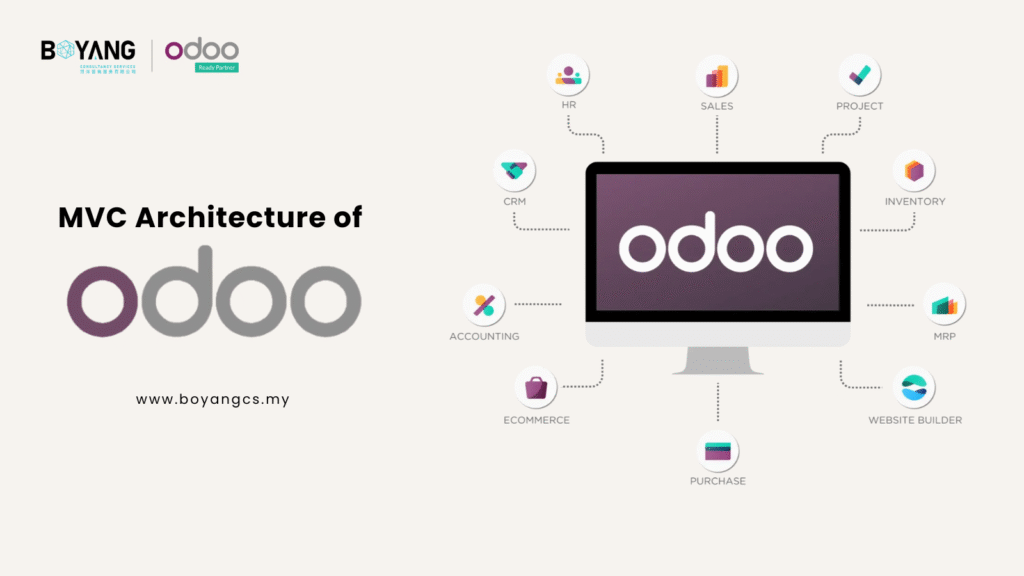
Every Odoo feature, CRM, Sales, Accounting, Inventory, exists as an independent module.
A module typically contains:
- Python models
- XML views
- Security rules
- Business workflows
- Data configurations
This modular architecture allows businesses to extend functionality without affecting core systems.
Views (XML Layer)
Odoo separates presentation from logic using XML-defined views.
Common view types include:
- Form Views
- List (Tree) Views
- Kanban Views
- Dashboards
- Reports
The XML view system ensures UI customization without modifying backend business logic.
Controllers (Python)
Controllers act as the bridge between users and system logic.
They:
- Handle HTTP requests
- Process user actions
- Call ORM methods
- Return rendered views or API responses
Custom controllers also enable portal development and external integrations.
API & RPC Integration
Odoo provides powerful integration capabilities through:
- XML-RPC
- JSON-RPC APIs
These APIs allow external systems, mobile apps, and third-party platforms to securely interact with Odoo data.
Odoo Server Role & Internal Structure
The Odoo Server functions as a high-level application server coordinating the entire MVC workflow.
Web Server (WSGI)
Odoo includes its own HTTP server but is commonly deployed behind:
- Nginx
- Apache
for improved security, SSL termination, and load handling.
Multi-Worker Architecture
Odoo supports a multi-worker (pre-forking) model, enabling:
- Concurrent user processing
- Better CPU utilization
- High-load enterprise performance
Automation & Scheduled Actions (Cron)
The server executes automated jobs such as:
- Scheduled reports
- Email automation
- Data synchronization
- Background workflows
Security & Access Control
Security in Odoo backend architecture is enforced through:
- Access Control Lists (ACLs)
- Record Rules
- User Roles & Groups
This ensures controlled data visibility across departments.
The Components of Odoo MVC Architecture
1. Model: The Data & Business Logic Layer
The Model in Odoo Model View Controller represents data structure and core business logic.
Implementation:
- Written as Python classes
- Uses Odoo’s built-in ORM
- Automatically maps to PostgreSQL tables
Responsibilities:
- Data storage & retrieval
- Business logic execution
- Validation rules
- Database interactions (create, search, write, unlink)
Instead of writing raw SQL, developers use Python ORM methods, making the Odoo framework architecture more secure and efficient.
2. View: The Presentation Layer
The View in MVC Architecture in Odoo controls how data is displayed to users.
Implementation:
- Defined using XML files
- Declarative UI definitions
Examples:
- Form Views
- Tree/List Views
- Kanban Views
- Dashboard Views
- Reports
The view focuses purely on presentation and user interaction, fully separated from business logic.
This is a key advantage of the Odoo MVC Pattern.
3. Controller: The Application Logic Manager
The Controller in Odoo Model View Controller acts as the mediator between Model and View.
Implementation:
- Python-based controllers
- Route decorators for handling HTTP requests
- Web controllers for custom APIs
Responsibilities:
- Receive user requests
- Call ORM methods
- Process workflows
- Render appropriate views
Odoo also uses a JavaScript-based MVC structure to manage client-side rendering and interaction in frontend. This layered approach strengthens the Odoo server role in MVC architecture.
How MVC Architecture Works in Odoo
Let’s understand how MVC architecture works in Odoo, step by step:
- A user interacts with the interface (View).
- The View sends a request to the Controller.
- The Controller processes the request.
- The Controller calls Model methods via ORM.
- The Model interacts with PostgreSQL database.
- Data is returned to the Controller.
- The Controller selects the appropriate View.
- The updated View is rendered in the browser.
This structured flow is what makes the Odoo MVC architecture explained so powerful and maintainable.
Role of Model View Controller in Odoo
The role of model view controller in Odoo is to enforce separation of concerns:
| Layer | Role |
| Model | Business logic & database operations |
| View | UI presentation |
| Controller | Workflow orchestration |
This separation allows:
- UI changes without affecting logic
- Business logic updates without redesigning views
- Easier debugging
- Better scalability
- Faster development cycles
For developers, this makes Odoo MVC architecture for developers extremely practical and structured.
Odoo Backend Architecture & Server Role
The Odoo backend architecture is Python-driven and runs on the Odoo server. architecture is based on a three-tier model (Client, Business Logic/Application, and Data) that relies on a modular framework built with Python, PostgreSQL, and XML. The Odoo server architecture handles:
- Module loading
- ORM processing
- Business logic execution
- API communication
- Security rules
- User authentication
The Odoo server role in MVC architecture is crucial because it coordinates controller execution and model interactions.
Without the server layer, the MVC pattern cannot function effectively.
Odoo Model View Controller Example
Let’s look at a simple Odoo model view controller example:
Scenario: Custom Sales Order Approval Module
Model (Python):
- Define approval field
- Add validation rule
View (XML):
- Add approval button
- Show approval status field
Controller (Python Route):
- Handle approval request
- Update order status
This shows how Model View Controller Odoo works together to deliver functionality cleanly and efficiently.
Why MVC Architecture is Important in Odoo ERP Implementation
For businesses planning Odoo ERP implementation in Malaysia, understanding the Odoo MVC Architecture is valuable because:
- It ensures long-term scalability
- Custom modules remain structured
- Maintenance costs are reduced
- Development becomes custom, faster and clean
- Faster feature deployments
- Upgrades are smoother
During any Odoo ERP implementation, MVC separation prevents system conflicts when adding new modules or customizations.
Odoo Design Pattern & Framework Architecture
The Odoo design pattern is based on:
- MVC pattern
- Modular architecture
- ORM-based database abstraction
- Service-oriented components
This makes the Odoo framework architecture flexible for enterprise-grade applications.
Developers benefit from well-structured Odoo documentation, which explains models, controllers, security, and views in detail.
How Success Pack Odoo Supports MVC-Based Implementation
Businesses that choose Odoo Success Pack services receive:
- Dedicated consultant guidance
- Business needs analysis and process mapping
- System configuration and module implementation
- Customization support for models and views
- Third-party system integration assistance
- Secure data migration to Odoo database
- Personalized user training and coaching
- Testing and go-live deployment support
- Ongoing support and system optimization within pack hours
The Odoo success pack helps companies deploy a clean MVC-based implementation aligned with business goals.
Advantages of Odoo MVC Architecture
The key advantages of Odoo MVC architecture are as follow:
- Clear separation of data, interface, and business logic
- Organized and modular code structure
- Faster and parallel development across teams
- Improved code maintainability and scalability
- Easier debugging and system troubleshooting
- High code reusability across applications
- Better testing and application reliability
- SEO-friendly structure for web and eCommerce modules
- Flexible customization and integration capabilities
- Strong security and access control management
- Scalable architecture suitable for enterprise growth
This is why Odoo MVC Architecture explained remains a critical concept for both developers and decision-makers.
Wrap-up
The MVC Architecture of Odoo is the foundation of its power, flexibility, and scalability.
By separating data (Model), presentation (View), and workflow logic (Controller), Odoo delivers a structured and maintainable ERP system to its users.
No mater what you are a developer building custom modules or a business planning an Odoo ERP implementation in Malaysia, understanding the Odoo Model View Controller architecture ensures long-term project success.
If you want a structured and professionally managed Odoo deployment, working with experienced Odoo consultants like Boyang, ensures your architecture remains clean, scalable, and future-ready.