
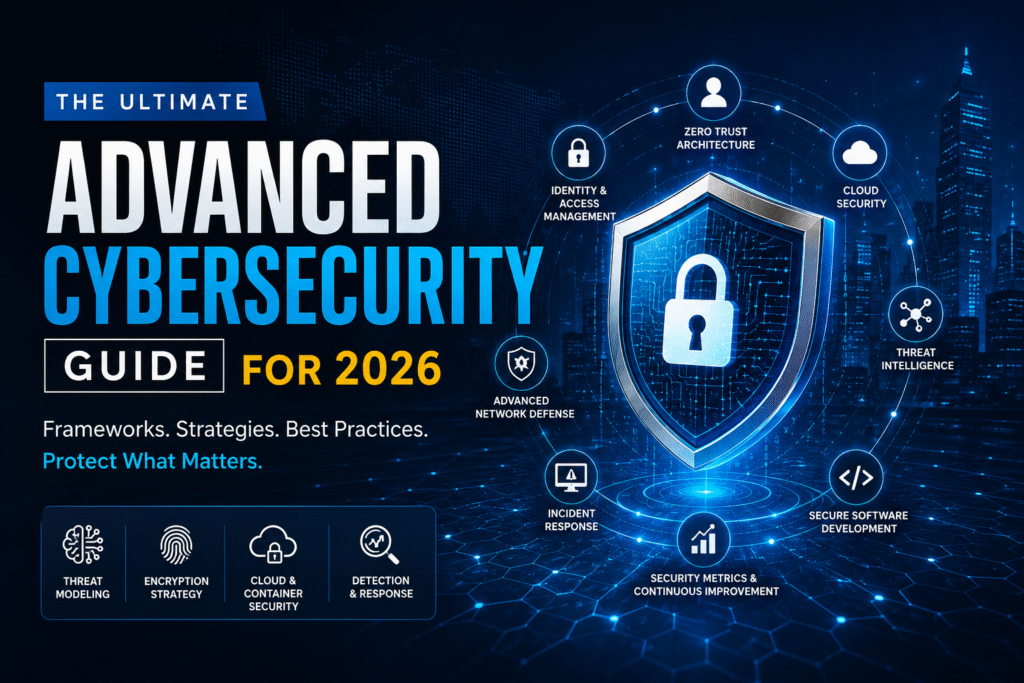
Cybersecurity is no longer just about installing antivirus software and setting up a firewall. Attackers today are sophisticated, patient, and well-resourced. They target your identity systems, your supply chain, your developers, and your cloud infrastructure.
This guide is for professionals who already understand the basics and want to go deeper. It covers the frameworks, techniques, and practical steps that serious security teams use to protect their systems in 2026.
1. Advanced Threat Modeling
Threat modeling is the process of identifying what threats exist, how likely they are, and what damage they cause. Most teams do this too late or too informally.
STRIDE Framework
STRIDE is one of the most widely used threat modeling methods. It covers six threat categories:
- Spoofing: An attacker pretends to be someone they are not.
- Tampering: Data or code gets modified without authorization.
- Repudiation: A user denies performing an action, and you have no proof they did.
- Information Disclosure: Sensitive data leaks to unauthorized parties.
- Denial of Service: A system becomes unavailable to legitimate users.
- Elevation of Privilege: A user gains more access than they should have.
How to Run a Threat Modeling Session
Start with a data flow diagram of your system. Draw every component, every data store, and every communication channel. Mark trust boundaries between components. Then walk through each boundary and ask: what threats exist here?
Assign each threat a severity score using DREAD or CVSS. Prioritize by risk, not by ease of fix. Assign ownership to each item and track it in your backlog like any other engineering task.
The most important rule: run threat modeling sessions at the design phase, not after development. A flaw found in design costs a fraction of what it costs to fix in production.
2. Zero Trust Architecture
Zero Trust is a security model built on one principle: trust nothing and verify everything. No user, device, or service gets automatic access, even if they are already inside your network.
The old perimeter model assumed that traffic inside the network was safe. That assumption is dangerous. Modern attacks use lateral movement to spread after initial access, making internal trust a liability.
The Three Core Pillars
Verify explicitly. Every access request gets authenticated and authorized using all available signals: user identity, device health, location, and behavioral patterns.
Use least privilege access. Users and services get only the permissions they need, for only as long as they need them. Remove standing privileges wherever possible.
Assume breach. Design your systems as if attackers are already inside. Segment your networks, encrypt all sessions, and monitor everything continuously.
Where to Start
Begin with identity. Deploy multi-factor authentication for every user account. Then build conditional access policies that factor in device compliance and login risk. After that, move to network microsegmentation to limit lateral movement.
Zero Trust is not a product you buy. It is a strategy you implement across identity, devices, applications, data, infrastructure, and network layers over time.
3. Advanced Network Defense
A firewall at the perimeter is not enough. Attackers who get past it move freely unless you have layered defenses inside the network.
Key Technologies
Network Detection and Response (NDR) monitors east-west traffic inside your network. This is where most modern attacks operate after they gain initial access. Traditional tools watch the perimeter only.
Intrusion Detection and Prevention Systems (IDS/IPS) watch for known attack signatures and anomalous behavior. Modern IPS systems block threats automatically based on rules and machine learning.
Security Information and Event Management (SIEM) aggregates logs from across your environment. A well-tuned SIEM surfaces real threats instead of generating thousands of false positives.
Microsegmentation divides your network into small zones. Each zone has its own access controls. If an attacker compromises one segment, they cannot move freely to others.
DNS Filtering blocks connections to known malicious domains before any traffic reaches them. Many command-and-control (C2) attacks rely on DNS, making this a high-value, low-cost control.
Practical Steps
Audit your firewall rules every quarter. Remove any rule that no longer has a documented business reason. Use network flow data to establish a baseline of normal traffic, then alert on deviations. Block all outbound traffic by default and whitelist only what is necessary.
4. Encryption Strategy
Encryption protects data in transit, at rest, and increasingly in use. Advanced teams treat encryption as a system, not a checkbox.
Encryption in Transit
Use TLS 1.3 for all network communication. Disable TLS 1.0, TLS 1.1, and all SSL versions across every service you operate. Enforce HTTPS using HTTP Strict Transport Security (HSTS) with a long max-age and include subdomains.
Use certificate pinning for mobile applications and high-value API connections. Rotate certificates before they expire and automate the process using tools like Let’s Encrypt or your cloud provider’s certificate manager.
Encryption at Rest
Encrypt every data store, every backup, and every disk. Use AES-256 as your baseline cipher. Store encryption keys separately from the data they protect. Use a dedicated key management service (KMS) such as AWS KMS, Azure Key Vault, or HashiCorp Vault.
Rotate keys on a defined schedule. Log every key access event. Set alerts for unusual key usage patterns.
Encryption in Use
Homomorphic encryption and confidential computing allow computation on encrypted data without decrypting it first. These technologies are still maturing but are production-ready in specific use cases such as financial data processing and healthcare analytics.
5. Identity and Access Management
Identity is the new perimeter. More breaches start with compromised credentials than with any other technique. Protecting identity is your highest-priority control.
Multi-Factor Authentication
Deploy MFA across every account, system, and application. Prioritize phishing-resistant MFA methods such as hardware security keys (FIDO2/WebAuthn) and passkeys over SMS-based codes.
SMS-based MFA is better than nothing, but SIM-swapping attacks have made it a weak control for high-value accounts. Replace it wherever you can.
Privileged Access Management
Privileged accounts are the highest-value targets for attackers. Apply strict controls:
- Use just-in-time (JIT) access to grant elevated permissions only when needed and revoke them automatically.
- Require separate accounts for administrative tasks, distinct from everyday user accounts.
- Record all privileged sessions. Review recordings after any anomaly.
- Disable shared administrative accounts entirely. Every action should trace to a specific person.
Identity Governance
Run access reviews on a quarterly basis. Remove accounts that are no longer active. Check for over-provisioned accounts that have accumulated permissions over time. Automate provisioning and deprovisioning through your HR system so accounts get disabled the moment an employee leaves.
6. Incident Response
How you respond to a breach determines how much damage it causes. Teams that have a tested, documented plan recover faster and suffer less data loss.
The Incident Response Lifecycle
Preparation. Build your incident response plan before you need it. Define roles, communication channels, escalation paths, and decision-making authority. Run tabletop exercises at least twice a year.
Detection and Analysis. Use your SIEM, NDR, and endpoint detection tools to identify incidents quickly. Establish mean time to detect (MTTD) as a tracked metric. The industry average is over 200 days. You want to be well below that.
Containment. Once you confirm an incident, contain it immediately. Isolate affected systems without shutting them down if possible, to preserve forensic evidence. Block attacker infrastructure at the network level.
Eradication. Remove the attacker’s foothold completely. This includes malware, backdoors, unauthorized accounts, and any persistence mechanisms. Do not rush this step. Incomplete eradication leads to reinfection.
Recovery. Restore systems from clean backups. Verify integrity before bringing systems back online. Monitor closely for signs of re-entry during this phase.
Post-Incident Review. Within two weeks of an incident, run a blameless post-mortem. Document what happened, what worked, what failed, and what changes you make to prevent recurrence.
Metrics to Track
- Mean time to detect (MTTD)
- Mean time to respond (MTTR)
- Number of incidents per quarter
- Percentage of incidents detected internally versus externally
- Cost per incident
7. Secure Software Development
Most vulnerabilities enter through code. Building security into your development process is more effective than scanning for it afterward.
Shift Left Security
Shift left means moving security earlier in the software development lifecycle. Instead of scanning code after it is written, you integrate security checks into every step.
Add static application security testing (SAST) to your CI/CD pipeline. It scans code automatically on every commit and blocks deployments with critical vulnerabilities. Add software composition analysis (SCA) to scan third-party libraries for known vulnerabilities.
Use dynamic application security testing (DAST) to test running applications before they reach production. DAST finds vulnerabilities that static analysis misses, such as authentication flaws and business logic errors.
Secure Coding Practices
Train developers on the OWASP Top 10 vulnerabilities. These include SQL injection, cross-site scripting (XSS), broken authentication, insecure deserialization, and security misconfiguration. These vulnerabilities have existed for decades and still appear in production code every day.
Enforce code review with a security focus. Create a security checklist that reviewers follow for any code that handles authentication, authorization, data input, or cryptography.
Secrets Management
Never store secrets in code. This includes API keys, database passwords, private keys, and tokens. Use a secrets management tool such as HashiCorp Vault, AWS Secrets Manager, or Azure Key Vault.
Scan your repositories for secrets automatically using tools like Gitleaks or truffleHog. Rotate any secrets that were ever committed to source control, regardless of how briefly.
8. Cloud Security
Cloud environments introduce configuration risks that did not exist in traditional data centers. Misconfiguration is the leading cause of cloud data breaches.
Cloud Security Posture Management
Use a Cloud Security Posture Management (CSPM) tool to continuously monitor your cloud environment for misconfigurations. It checks settings against security benchmarks such as CIS Benchmarks and alerts on violations.
Common misconfigurations to eliminate immediately:
- Public S3 buckets or equivalent open storage
- Unrestricted inbound rules in security groups
- Root account with no MFA
- Overly permissive IAM roles
- Logging disabled on critical services
Infrastructure as Code Security
If you manage infrastructure through code (Terraform, CloudFormation, Pulumi), scan that code for security issues before deployment. Tools like Checkov and tfsec integrate with CI/CD pipelines and block insecure infrastructure changes.
Treat infrastructure code with the same security rigor you apply to application code. Version control it, review it, and audit changes.
Container and Kubernetes Security
Scan container images for vulnerabilities before pushing them to production. Use minimal base images to reduce attack surface. Never run containers as root.
In Kubernetes, apply the principle of least privilege to every pod. Use network policies to restrict pod-to-pod communication. Disable the default service account token auto-mount unless a pod explicitly needs it.
9. Threat Intelligence
Threat intelligence gives your security team context. It tells you who is targeting your industry, what tools they use, and what indicators of compromise (IOCs) to watch for.
Types of Threat Intelligence
Strategic intelligence is high-level information about threat actors, their motivations, and their targets. It informs executive decisions and security investment priorities.
Tactical intelligence covers the tactics, techniques, and procedures (TTPs) that attackers use. The MITRE ATT&CK framework is the most comprehensive public database of TTPs and maps directly to defensive controls.
Operational intelligence gives specific, timely information about active threats. This includes IOCs such as malicious IP addresses, domain names, file hashes, and email headers.
Applying Threat Intelligence
Feed IOCs into your SIEM, firewall, and DNS filtering tools automatically. Use a threat intelligence platform (TIP) to aggregate feeds from multiple sources and deduplicate them.
Join industry-specific information sharing groups such as ISACs (Information Sharing and Analysis Centers). These groups share threat intelligence in real time with organizations in the same sector.
Map your detection rules to ATT&CK techniques. Identify which techniques you have coverage for and which you do not. Prioritize building detection for uncovered techniques that are common in attacks against your industry.
10. Security Metrics and Continuous Improvement
Security without measurement is guesswork. Define the metrics that matter, track them consistently, and use them to drive decisions.
Key Security Metrics
- Vulnerability mean time to remediate (MTTR): How long does it take to patch a critical vulnerability after discovery?
- Patch coverage: What percentage of your systems are up to date?
- MFA adoption rate: What percentage of accounts have MFA enabled?
- Detection coverage: What percentage of MITRE ATT&CK techniques do your detections cover?
- Security training completion: What percentage of staff have completed security awareness training?
Building a Continuous Improvement Program
Run red team exercises annually. Red teams simulate real attackers and test your detection and response capabilities in realistic conditions. Use findings to drive specific, measurable improvements.
Conduct penetration testing before every major product launch and after significant infrastructure changes. Use the same testing firm for baseline comparisons and rotate firms every few years for fresh perspective.
Benchmark your security program against frameworks such as NIST CSF, ISO 27001, or SOC 2. These frameworks give you a structured way to identify gaps and demonstrate maturity to customers and auditors.
Final Thoughts
Advanced cybersecurity is not about deploying more tools. It is about making deliberate, evidence-based decisions about where your risks are highest and applying the right controls in the right order.
Start with identity and access management. Layer in threat detection. Build security into your development process. Measure everything. Review and improve continuously.
The organizations that handle security well do not treat it as a separate function. They treat it as a core part of how they build, operate, and ship. That mindset, applied consistently, is what separates teams that detect and respond quickly from those that read about themselves in breach reports.